Capturing the Joy of Childhood in Every Letter
There is a specific kind of energy that comes from looking at a child’s drawing. It is unpolished, confident, and full of life. When we try to replicate that feeling in professional design, we often end up with something that feels forced or overly stylized. However, finding a typeface that genuinely captures that spontaneous spirit without sacrificing legibility is a game-changer for anyone working in the education, parenting, or entertainment sectors. This is where a tool like Children’s Scribbles enters the conversation, offering a bridge between professional design standards and the raw, whimsical aesthetic of a kindergartener’s notebook.
More Than Just Messy Lines
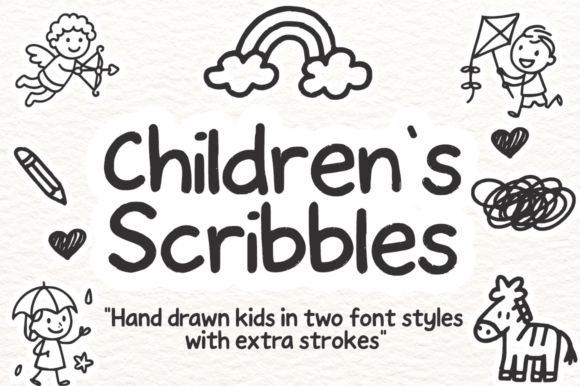
At first glance, you might categorize this simply as a handwritten font, but it deserves a more nuanced description. It functions as a display typeface that mimics the learning process of handwriting. The letterforms are round, light, and legible—crucial factors when your audience is just learning to read. Unlike many novelty fonts that prioritize style over function, this typeface maintains high readability even at smaller sizes.
What sets it apart visually is the accompanying set of doodle elements. We aren’t just talking about standard dingbats; these are illustrations of clouds, hearts, animals, and figures that feel drawn by the same hand that wrote the text. This creates a cohesive visual language that is difficult to achieve when pairing a standard sans serif font with stock vector illustrations. It provides a distinct personality that feels endearing and cheerful, instantly putting a viewer in a positive, playful mood.
Strategic Applications for Brand Identity
For small business owners and entrepreneurs, specifically those in the childcare or educational space, visual consistency is key to brand recognition. Using a premium font like Children’s Scribbles across your assets helps cement your identity as approachable and fun.
Consider the following practical applications where this typeface shines:
- Logo Design: If you are launching a tutoring service, a pediatric clinic, or a toy brand, a logo utilizing this font immediately signals your target demographic. It suggests a safe, creative, and nurturing environment.
- Packaging Design: For products like snacks, school supplies, or craft kits, the packaging needs to jump off the shelf. The vibrant aesthetics of this font make it perfect for headers and call-outs on boxes and labels.
- Editorial Layouts: Magazine editors working on family-focused publications can use this for pull quotes or section headers to break the monotony of standard body text, adding a touch of whimsy to the layout.
- Merchandise: T-shirts, tote bags, and stickers are massive markets. A creative font that looks hand-drawn translates exceptionally well to fabric and physical goods, giving items a boutique, artisanal feel.
Enhancing Digital Presence and Marketing
In the realm of web design and social media graphics, standing out is a battle for attention. A playful typeface can serve as a pattern interrupt in a user’s feed. When scrolling through polished, corporate aesthetics, a post featuring the raw, energetic vibe of a scribble font can stop the thumb.
Content creators and bloggers can use Children’s Scribbles to create engaging thumbnails, featured images, or infographics that explain complex topics in a digestible way. It is particularly effective for "mommy bloggers," homeschool influencers, or early childhood educators sharing resources. Furthermore, for digital products like printable planners or educational worksheets, using a font that mimics a child’s writing helps bridge the gap between the teacher and the student, making the material feel less intimidating and more inviting.
Technical Considerations and Font Pairings
While the aesthetic is loose and free, your approach to using it should be strategic. As a designer, you know that readability is paramount. Because Children’s Scribbles is a display font, it is best suited for headlines, titles, and short bursts of text. Using it for long paragraphs of body copy would likely strain the reader's eyes.
To build a professional presentation, you must master the art of font pairing. You need a stable, grounding partner for your playful headline. Here are a few suggestions:
- Pair with a Geometric Sans Serif: A clean, modern sans serif (like Montserrat or Poppins) provides a neutral canvas that lets the personality of the scribble font pop without creating visual chaos.
- Pair with a Rounded Serif: For a softer, more storybook vibe, a serif font with rounded terminals can complement the soft edges of the doodles.
- Color Theory: Don't stick to black. The "sketch" nature of the letters pairs beautifully with pastel backgrounds or bright, primary colors to reinforce that classroom aesthetic.
Always test your typography at various scales. Check how the distinct letters look when scaled down on a mobile screen versus a large poster print. Because the font includes those unique doodle elements, ensure they don't get lost in the noise of a busy background image.
Licensing and Project Scope
Finally, before integrating any new design asset into your workflow, review the licensing terms. If you are a freelancer creating a logo for a client, or a business owner printing thousands of units of packaging, you need to ensure the commercial font license covers your specific use case. Most high-quality foundries offer different tiers for desktop, web, and app usage.
Ultimately, Children’s Scribbles is more than just a collection of letters; it is a tool for storytelling. It allows you to tap into the nostalgia and innocence of childhood, making it an invaluable asset for anyone looking to inject a dose of genuine happiness into their visual communication. Whether you are designing a poster for a school play or a landing page for a new educational app, this typeface provides the "stardust" needed to make your project feel alive.